Stop “Working Toward” Tenure. Start Engineering It.
Every junior faculty member in engineering is introduced, sooner or later, to the so-called four-headed monster: PhD students, publications, extramural funding, and external validation. The message is usually framed in reassuring terms: manage all four, balance them carefully, and tenure will follow.
This is comforting advice. It is also deeply misleading.
These four are not simply parts of the job. They are the outputs that ultimately matter for tenure. Everything else, including teaching and service, is evaluated based on how it contributes to them.
The four do not pull in parallel. They form a system disguised as a list, with one element feeding the others:
- Funding drives students
- Students produce papers
- Papers generate visibility
- Visibility supports future funding
What is often described as balance is, in reality, a feedback loop with a clear starting point. And that starting point is extramural funding.
Treat all four as equal, and you will stay busy.
Recognize that they are connected, and you begin to build momentum.
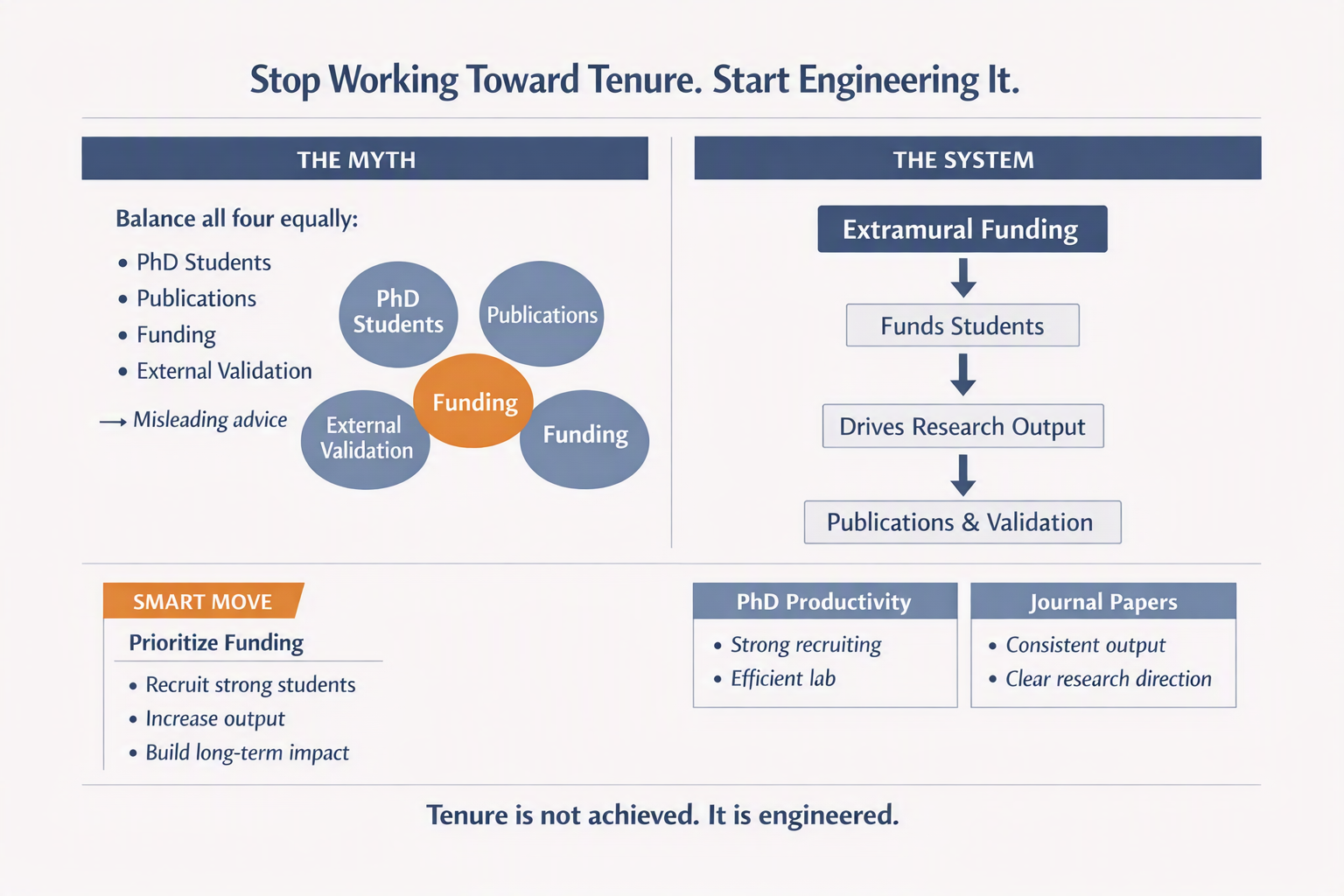 Funding is not just one of the four. It is the driver of the system. Without it, even strong ideas struggle to translate into sustained research. Graduate students do not appear out of interest alone. They follow resources, continuity, and the promise of meaningful work.
This is where the illusion of balance breaks down. Mentoring does not begin in the lab. It begins with a funded project. Without funding, recruiting strong students becomes difficult. Without strong students, research productivity becomes inconsistent.
Once students are in place, the second output, publications, follows. Papers are often treated as direct products of effort, but in practice, they emerge from an already functioning system. Funded students generate data, explore ideas, and produce manuscripts. When the pipeline is supported, output becomes steady. When it is not, productivity becomes episodic and fragile.
External validation works the same way. Visibility in the field is not created in isolation. It comes from sustained activity, talks, collaborations, and papers encountered over time. That level of visibility is rarely maintained without a productive and funded research program.
Within departments, the same structure quietly shapes evaluation. Colleagues may speak the language of balance, but they respond to evidence of momentum. A faculty member with funded projects, student support, and consistent output signals independence and a clear trajectory. In that context, teaching and service are viewed differently.
This leads to the point that is often left unsaid.
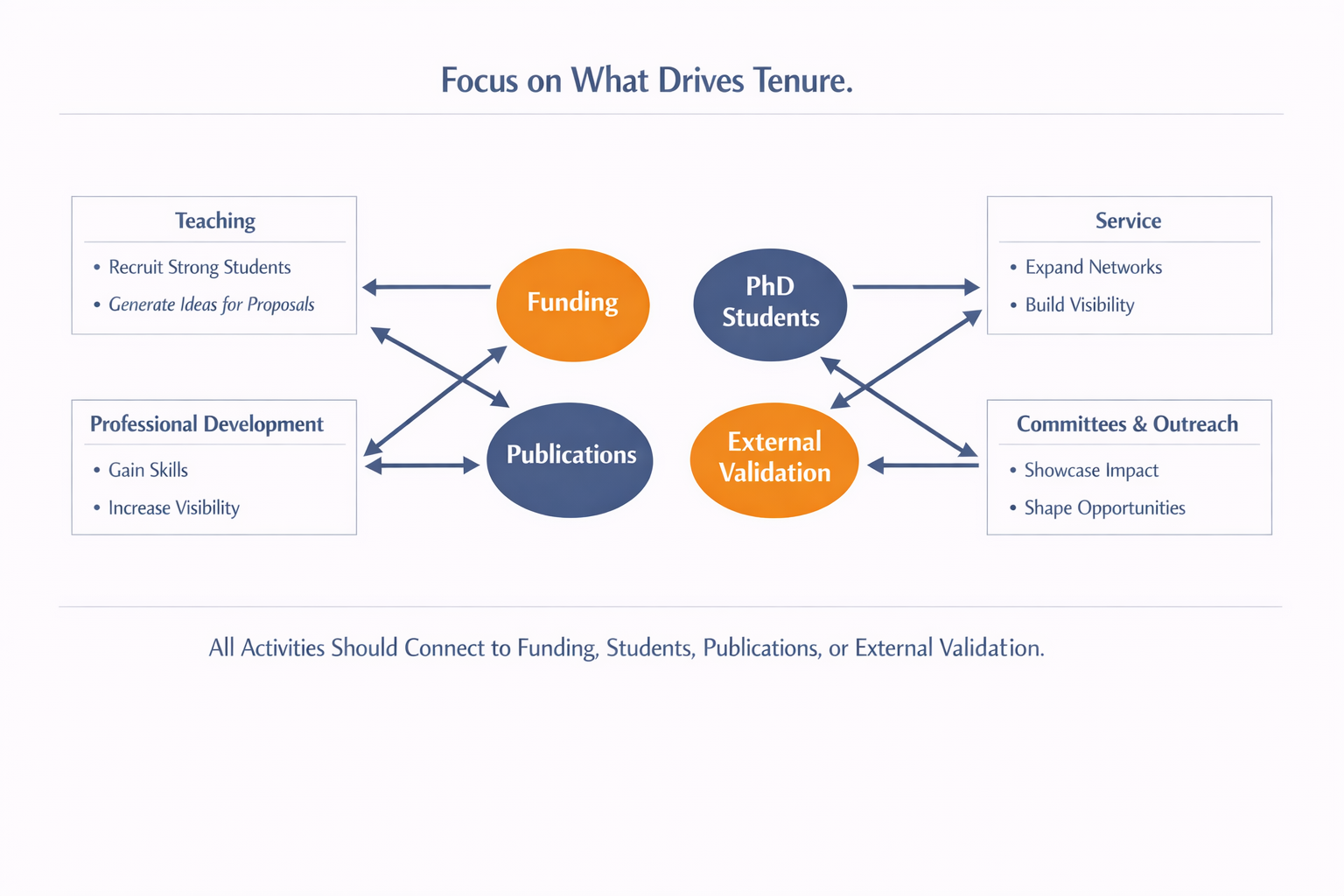
Teaching and service matter, but they do not stand alone. Their value depends on how they feed the four outputs.
Teaching can become a recruiting mechanism. It can expose strong students to research opportunities. It can generate ideas that evolve into proposals. It can build visibility through educational innovation. When aligned properly, it strengthens the system.
Service can expand networks, connect you to communities, and increase visibility. It can position you for collaborations and future funding opportunities. But when service is disconnected from research growth, it consumes time without advancing the system.
The issue is not whether to teach or serve. The issue is whether those activities contribute to funding, students, publications, or external validation.
A more effective approach begins with a simple question:
Does this activity contribute to securing funding, supporting students, producing publications, or strengthening external evaluation?
If the answer is yes, it has a place.
If the answer is no, it needs to be reconsidered or reshaped.
The risk in early faculty careers is rarely a lack of effort. It is misallocation. Time is spread across too many obligations that feel important but do not compound.
There is also a subtler trap. It is easy to become immersed in technical details, refining analyses, perfecting code, and optimizing experiments. These are satisfying and necessary tasks, but when they come at the expense of proposal development and program building, they shift the role from that of a system builder to that of an individual contributor.
Progress slows not because of insufficient work, but because effort is applied in the wrong place.
The shift required is both practical and cognitive. Instead of trying to balance everything, you begin to design a system. You prioritize activities that create leverage. You recognize that not all work carries equal weight. And you ensure that even necessary responsibilities like teaching and service reinforce rather than compete with the core engine.
Seen this way, the four-headed monster is not a set of competing demands. It is a connected system with a clear structure. Funding feeds students. Students produce papers. Papers build visibility. Visibility supports future funding. Teaching and service either strengthen this cycle or fragment it.
Tenure is not awarded for effort alone. It is awarded for building and sustaining this system.
And once that is understood, the goal is no longer to manage responsibilities. It is to engineer outcomes.
Tenure is not achieved. It is engineered.