Finding the inverse error function

Inverse Error Function

This post is brought to you by Holistic Numerical Methods: Numerical Methods for the STEM undergraduate at http://nm.mathforcollege.com, the textbook on Numerical Methods with Applications available from the lulu storefront, and the YouTube video lectures available at http://nm.mathforcollege.com/videos and http://www.youtube.com/numericalmethodsguy

Subscribe to the blog via a reader or email to stay updated with this blog. Let the information follow you.
Solving a polynomial equation for the longest mast problem?

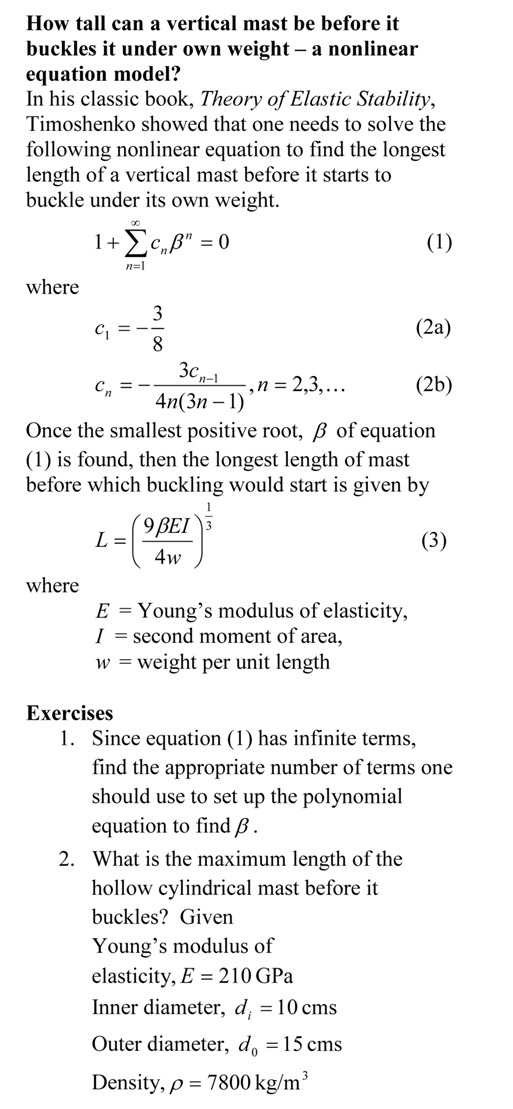
In the previous post, http://autarkaw.wordpress.com/2010/06/10/a-real-life-example-of-having-to-solve-a-nonlinear-equation-numerically/, we set up the polynomial equation for the problem of finding the length of the mast before which it buckles under its own weight.  In this blog, we show you how the polynomial equation is solved.  Since the polynomial equation has infinite terms, we also show you how we choose how many terms of the polynomial need to be used.

It is better to download the program as single quotes in the pasted version do not translate properly when pasted into a mfile editor of MATLAB or you can read the html version for clarity and sample output .

%% FINDING THE SMALLEST POSITIVE ROOT OF A POLYNOMIAL EQUATION FOR A
% In a previous blog at autarkaw.wordpress.com (June 10), we set up a
% polynomial equation that would allow us to find the longest mast
% that can be setup before it buckles under its own weight.
% In this blog, we will find the root of this equation.
% The problem is given at
% http://nm.mathforcollege.com/blog/length_of_mast.pdf
% and we are solving Exercise 1 of the pdf file.

%% TOPIC
% Smallest positive root of a polynomial equations with infinite terms

%% SUMMARY

% Language : Matlab 2008a;
% Authors : Autar Kaw;
% Mfile available at
% http://nm.mathforcollege.com/blog/rootinfinite.m;
% Last Revised : July 4, 2010
% Abstract: This program shows you how to find the smallest positive
% real root of a polynomial equations with infinite terms
clc
clear all

%% INTRODUCTION

disp(‘ABSTRACT’)
disp(‘   This program shows you how to’)
disp(‘   find the smallest positive real root’)
disp(‘   of a polynomial equations with infinite terms’)
disp(‘ ‘)
disp(‘AUTHOR’)
disp(‘   Autar K Kaw of http://autarkaw.wordpress.com’)
disp(‘ ‘)
disp(‘MFILE SOURCE’)
disp(‘   http://nm.mathforcollege.com/blog/rootsinfinite.m’)
disp(‘  ‘)
disp(‘PROBLEM STATEMENT’)
disp(‘   http://nm.mathforcollege.com/blog/length_of_mast.pdf)
disp(‘ ‘)
disp(‘LAST REVISED’)
disp(‘   July 4, 2010’)
disp(‘ ‘)

%% INPUTS
% prespecified tolerance, eps
eps=0.000001;
% maximum number of terms of polynomial
nmax=100;

%% DISPLAYING INPUTS

disp(‘INPUTS’)
fprintf(‘ The max number of terms of the polynomial chosen, nmax= %g’,nmax)
fprintf(‘\n The prespecified tolerance, eps= %g’,eps)
disp(‘  ‘)
disp(‘  ‘)

%% CODE
for N=2:1:nmax
    % The above looop is to see how many terms we should take of the
    % infinite polynomial
  aa(1)=-3.0/8.0;
    % Setting up the polynomial via recursive relations
for i=2:1:N
  aa(i)=-3*aa(i-1)/(4*i*(3*i-1));
end
% Since it is a polynomial of order N,
% there are N+1 coefficients
% To set up the polynomial for MATLAB
% N+1 th coefficient is the constant term
% N th coefficient is the term of order 1
% and so on till 1st coefficient is of order N
bb(N+1)=1;
for i=1:1:N
    bb(N-i+1)=aa(i);
end

% Finding all the roots of the Nth order polynomial
abc=roots(bb);

% Finding the first real positive root so that it
% would be used as the starting minimum value available
for i=1:1:N
    if isreal(abc(i))==true & abc(i)>0
        minval=abc(i);
        break;
    end
end

% Finding the smallest positive real root

for i=1:1:N
    if isreal(abc(i))==true & abc(i)>0
        if (abc(i) < minval)
            minval=abc(i);
        end
    end
end
% Checking if prespecified tolerance is met
if N>2
    absea=abs((minval-previous)/minval)*100;
    if absea<=eps
        terms_needed=N;
        break;
    end
end
previous=minval;
end

%% DISPLAYING OUTPUTS

disp(‘OUTPUTS’)
fprintf(‘ The number of terms used in the polynomial is %g’,terms_needed)
fprintf(‘\n The smallest positive real root is %g’,minval)
disp(‘  ‘)

________________________________________________________

This post is brought to you by Holistic Numerical Methods: Numerical Methods for the STEM undergraduate at http://nm.mathforcollege.com, the textbook on Numerical Methods with Applications available from the lulu storefront, and the YouTube video lectures available at http://www.youtube.com/numericalmethodsguy.

Subscribe to the blog via a reader or email to stay updated with this blog. Let the information follow you.
A real-life example of having to solve a nonlinear equation numerically?

_______________________________________________

This post is brought to you by Holistic Numerical Methods: Numerical Methods for the STEM undergraduate at http://nm.mathforcollege.com, the textbook on Numerical Methods with Applications available from the lulu storefront, and the YouTube video lectures available at http://nm.mathforcollege.com/videos and http://www.youtube.com/numericalmethodsguy

Subscribe to the blog via a reader or email to stay updated with this blog. Let the information follow you.
Converting large numbers into floating point format by hand

__________________________________________________

This post is brought to you by Holistic Numerical Methods: Numerical Methods for the STEM undergraduate at http://nm.mathforcollege.com, the textbook on Numerical Methods with Applications available from the lulu storefront, and the YouTube video lectures available at http://nm.mathforcollege.com/videos and http://www.youtube.com/numericalmethodsguy

Subscribe to the blog via a reader or email to stay updated with this blog. Let the information follow you.
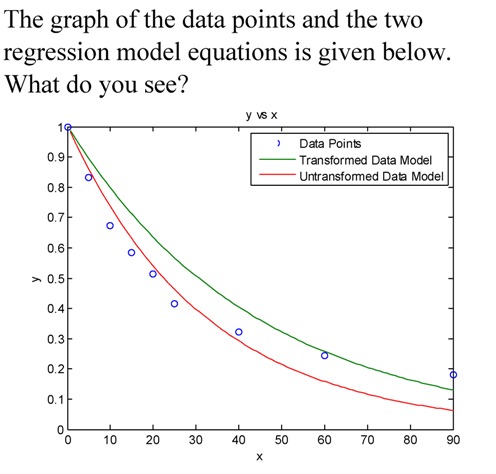
Does it make a large difference if we transform data for nonlinear regression models

__________________________________________________

This post is brought to you by Holistic Numerical Methods: Numerical Methods for the STEM undergraduate at http://nm.mathforcollege.com, the textbook on Numerical Methods with Applications available from the lulu storefront, and the YouTube video lectures available at http://nm.mathforcollege.com/videos and http://www.youtube.com/numericalmethodsguy

Subscribe to the blog via a reader or email to stay updated with this blog. Let the information follow you.
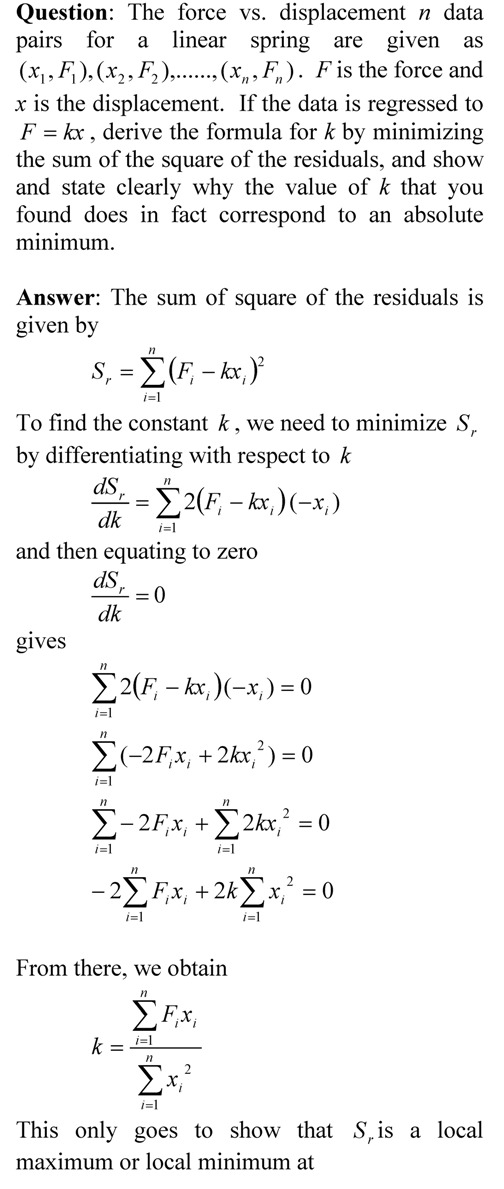
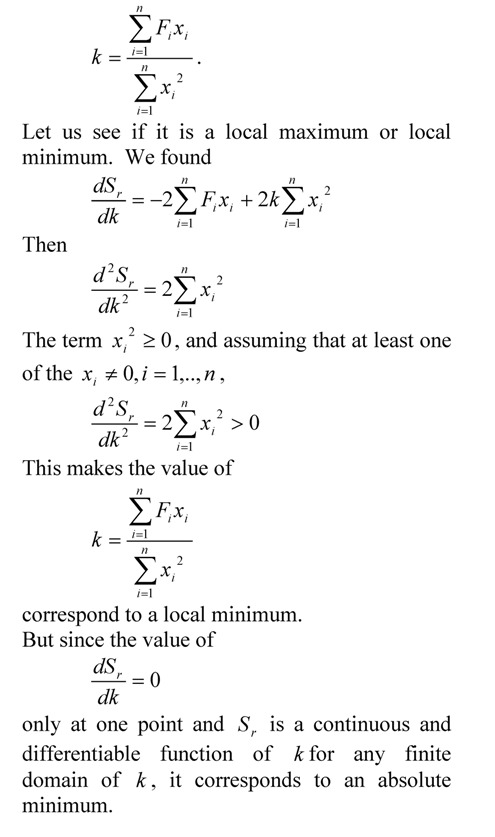
To prove that the regression model corresponds to a minimum of the sum of the square of the residuals

Many regression models when derived in books only show the first derivative test to find the formulas for the constants of a regression model.  Here we take a  simple example to go through the complete derivation.

Finding minimum of sum of square of residuals

Minimum of sum of square of residuals

_________________________________________________________

This post is brought to you by Holistic Numerical Methods: Numerical Methods for the STEM undergraduate at http://nm.mathforcollege.com, the textbook on Numerical Methods with Applications available from the lulu storefront, and the YouTube video lectures available at http://nm.mathforcollege.com/videos and http://www.youtube.com/numericalmethodsguy

Subscribe to the blog via a reader or email to stay updated with this blog. Let the information follow you.
A short online quiz for the MATLAB conditional statements

Frequent testing has been proven to be effective in learning.  Here we have an online quiz on MATLAB conditional statements (only if-then-else), where some of the questions are calculated (meaning that the numbers in these questions change when you retake the quiz).  So give it a try.
http://nm.mathforcollege.com/EML3041/studymate/MATLABifelseend.htm

_____________________________________________________

This post is brought to you by Holistic Numerical Methods:  Transforming Numerical Methods for the STEM undergraduate at http://nm.mathforcollege.com, the textbook on Numerical Methods with Applications available from the lulu storefront, and the YouTube video lectures available at http://nm.mathforcollege.com/videos and http://www.youtube.com/numericalmethodsguy

Subscribe to the blog via a reader or email to stay updated with this blog. Let the information follow you.

A short online quiz on the for-end loops in MATLAB

Frequent testing has been proven to be effective in learning.  Here we have an online quiz on MATLAB loops (just the for-end loops in this quiz), where some of the questions are calculated (meaning that the numbers in these questions change when you retake the quiz).  So give it a try and soon we will be adding questions on other programming basics.
http://nm.mathforcollege.com/EML3041/studymate/MATLABforendloops.htm

____________________________________________________

This post is brought to you by Holistic Numerical Methods: Numerical Methods for the STEM undergraduate at http://nm.mathforcollege.com, the textbook on Numerical Methods with Applications available from the lulu storefront, and the YouTube video lectures available at http://nm.mathforcollege.com/videos and http://www.youtube.com/numericalmethodsguy

Subscribe to the blog via a reader or email to stay updated with this blog. Let the information follow you.

A video tutorial on Simpson’s 1/3 rule

Simpson’s 1/3 rule is a popular method of conducting numerical integration.  We have recorded a series of short videos on this topic and they are avilable as a playlist at http://www.youtube.com/user/numericalmethodsguy#g/c/2A25C3DC6D8E5616.

This post is brought to you by Holistic Numerical Methods: Numerical Methods for the STEM undergraduate at http://nm.mathforcollege.com, the textbook on Numerical Methods with Applications available from the lulu storefront, and the YouTube video lectures available at http://nm.mathforcollege.com/videos and http://www.youtube.com/numericalmethodsguy

Subscribe to the blog via a reader or email to stay updated with this blog. Let the information follow you.

A short online quiz on MATLAB basics

Frequent testing has been proven to be effective in learning.  Here we have an online quiz on MATLAB basics, where some of the questions are calculated (meaning that the numbers in these questions change when you retake the quiz).  So give it a try and soon we will be adding questions on programming basics.
http://nm.mathforcollege.com/EML3041/studymate/matlabbasics.htm

This post is brought to you by Holistic Numerical Methods: Numerical Methods for the STEM undergraduate at http://nm.mathforcollege.com, the textbook on Numerical Methods with Applications available from the lulu storefront, and the YouTube video lectures available at http://nm.mathforcollege.com/videos and http://www.youtube.com/numericalmethodsguy

Subscribe to the blog via a reader or email to stay updated with this blog. Let the information follow you.