This is my first attempt to use livescribe as a teaching tool.
http://www.livescribe.com/cgi-bin/WebObjects/LDApp.woa/wa/MLSOverviewPage?sid=STsnTp8ssjNh
Numerical Methods for the STEM Undergraduate
This is my first attempt to use livescribe as a teaching tool.
http://www.livescribe.com/cgi-bin/WebObjects/LDApp.woa/wa/MLSOverviewPage?sid=STsnTp8ssjNh
In a recent blog about the MATLAB solve command, I mentioned that the solve command was not giving us the unique real solution to a physical problem. A user at MATLAB suggested declaring the syms variable as real, before using the solve command. That worked. So if the equation in terms of the variable b is eqnb=0, then use
syms b real;
solve (eqnb,b);
____________________________________________
This post is brought to you by Holistic Numerical Methods: Numerical Methods for the STEM undergraduate at http://nm.mathforcollege.com, the textbook on Numerical Methods with Applications available from the lulu storefront, the textbook on Introduction to Programming Concepts Using MATLAB, and the YouTube video lectures available athttp://nm.mathforcollege.com/videos. Subscribe to the blog via a reader or email to stay updated with this blog. Let the information follow you.
Recently, I had assigned a project to my class where they needed to regress n number of x-y data points to a nonlinear regression model y=exp(b*x). However, they were NOT allowed to transform the data, that is, transform data such that linear regression formulas can be used to find the constant of regression b. They had to do it the new-fashioned way: Find the sum of the square of the residuals and then minimize the sum with respect to the constant of regression b.
To do this, they conducted the following steps
However, the solve command gave some odd answer like log(z1)/5 + (2*pi*k*i)/5. The students knew that the equation has only one real solution – this was deduced from the physics of the problem.
We did not want to set up a separate function mfile to use the numerical solvers such as fsolve. To circumvent the setting up of a separate function mfile, we approached it as follows. If dbsr=0 is the equation you want to solve, use
F = vectorize(inline(char(dbsr)))
fsolve(F, -2.0)
What char command does is to convert the function dbsr to a string, inline constructs it to an inline function, vectorize command vectorizes the formula (I do not fully understand this last part myself or whether it is needed).
% Program to get the quadrature points
% and weight for Gauss-Legendre Quadrature
% Rule
clc
clear all
syms x
% Input n: Quad pt rule
n=14;
% Calculating the Pn(x)
% Legendre Polynomial
% Using recursive relationship
% P(order of polynomial, value of x)
% P(0,x)=1; P(1,x)=0;
% (i+1)*P(i+1,x)=(2*i+1)*x*P(i,x)-i*P(i-1,x)
m=n-1;
P0=1;
P1=x;
for i=1:1:m
Pn=((2.0*i+1)*x*P1-i*P0)/(i+1.0);
P0=P1;
P1=Pn;
end
if n==1
Pn=P1;
end
Pn=expand(Pn);
quadpts=solve(vpa(Pn,32));
quadpts=sort(quadpts);
% Finding the weights
% Formula for weights is given at
% http://mathworld.wolfram.com/Legendre-GaussQuadrature.html
% Equation (13)
for k=1:1:n
P0=1;
P1=x;
m=n;
% Calculating P(n+1,x)
for i=1:1:m
Pn=((2.0*i+1)*x*P1-i*P0)/(i+1.0);
P0=P1;
P1=Pn;
end
Pn=P1;
weights(k)=vpa(2*(1-quadpts(k)^2)/(n+1)^2/ …
subs(Pn,x,quadpts(k))^2,32);
end
fprintf(‘Quad point rule for n=%g \n’,n)
disp(‘ ‘)
disp(‘Abscissas’)
disp(quadpts)
disp(‘ ‘)
disp(‘Weights’)
disp(weights’)_______________________________________________________
In a short 2.5 years since starting the numericalmethodsguy YouTube channel in January 2009, this month the channel crossed the benchmark of receiving 1 million video views. Currently the channel gets between 2,500-3,500 video views per day. Although we have playlists on the channel, the playlist for all the available topics are given on single webpage at http://nm.mathforcollege.com/videos/index.html
Complete resources on each topic of available numerical methods including textbook chapters, videos, multiple-choice tests, PPTs, and worksheets are given at http://nm.mathforcollege.com/topics/textbook_index.html
__________________________________________________
This post is brought to you by Holistic Numerical Methods: Numerical Methods for the STEM undergraduate at http://nm.mathforcollege.com, the textbook on Numerical Methods with Applications available from the lulu storefront, the textbook on Introduction to Programming Concepts Using MATLAB, and the YouTube video lectures available at http://nm.mathforcollege.com/videos. Subscribe to the blog via a reader or email to stay updated with this blog. Let the information follow you.
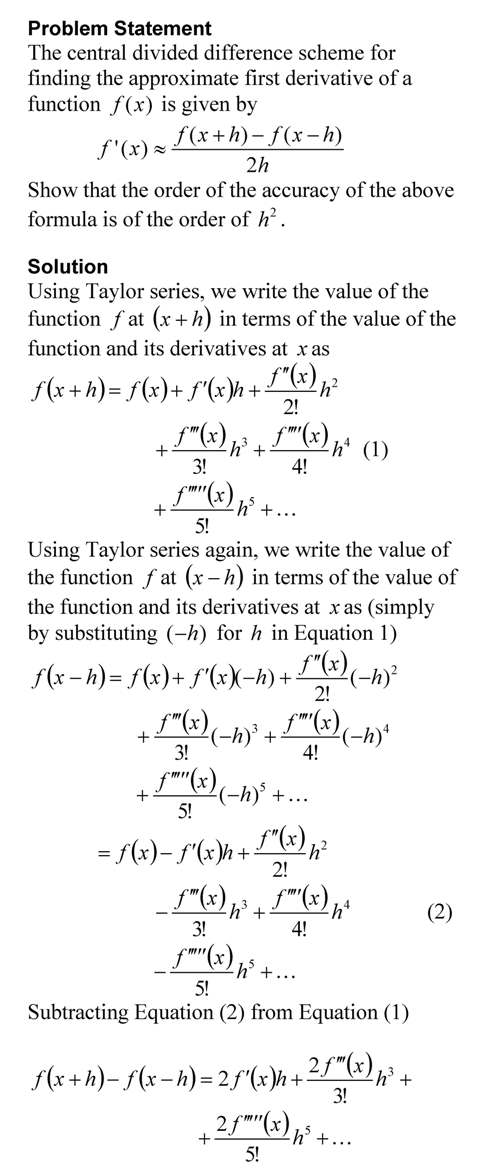
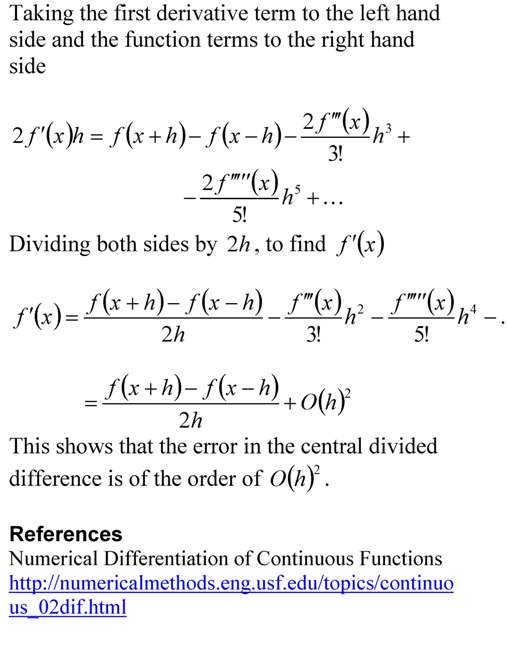


This post is brought to you by
Holistic Numerical Methods: Numerical Methods for the STEM undergraduate at http://nm.mathforcollege.com, the textbook on Numerical Methods with Applications available from the lulu storefront, the textbook on Introduction to Programming Concepts Using MATLAB, and the YouTube video lectures available at http://nm.mathforcollege.com/videos. Subscribe to the blog via a reader or email to stay updated with this blog. Let the information follow you.
 .
.Reference: Floating Point Representation
This post is brought to you by
Holistic Numerical Methods: Numerical Methods for the STEM undergraduate at http://nm.mathforcollege.com, the textbook on Numerical Methods with Applications available from the lulu storefront, the textbook on Introduction to Programming Concepts Using MATLAB, and the YouTube video lectures available at http://nm.mathforcollege.com/videos. Subscribe to the blog via a reader or email to stay updated with this blog. Let the information follow you.
