Faculty are often convinced about the why of pre‑class preparation but struggle with the how: how do you design resources that students actually use, without creating an unsustainable workload for yourself? In our recent work on developing pre-class learning modules across five core engineering courses, we distilled a set of practical, field-tested tips that go beyond theory and into day-to-day teaching practice. This post expands on those tips and shows how they fit together into a coherent, scalable approach to improving student preparedness and success.
Start With a Design Framework, Not Just Content
One of the most important lessons we learned is that effective pre‑class learning begins with instructional design, not with recording videos or uploading readings. Before building modules in the LMS, instructors benefited from becoming familiar with structured design frameworks such as Quality Matters. These frameworks emphasize clarity, alignment, and accessibility without prescribing pedagogy or limiting instructor autonomy.
Even for faculty who primarily teach face‑to‑face courses, the discipline of online course design pays dividends. Clearly articulated learning objectives, intentional sequencing of materials, and alignment among objectives, content, and assessment help students understand why they are engaging with pre-class materials and how those materials support in-class learning.
Use the LMS to Create an instructor‑Guided Path
Learning management systems offer many navigation options, but more choices are not always better for students. We found it highly effective to design pre-class content so that students access everything through Modules rather than having materials scattered across assignments, quizzes, files, and pages.
By hiding redundant navigation links and guiding students along a single, clearly defined path, instructors eliminate ambiguity about expectations. This approach reduces surface‑level strategies—such as students jumping straight to graded items—and encourages engagement with the full learning sequence. Similarly, disabling auto‑generated syllabus summaries prevents students from treating the course as a checklist of deadlines rather than a learning experience.
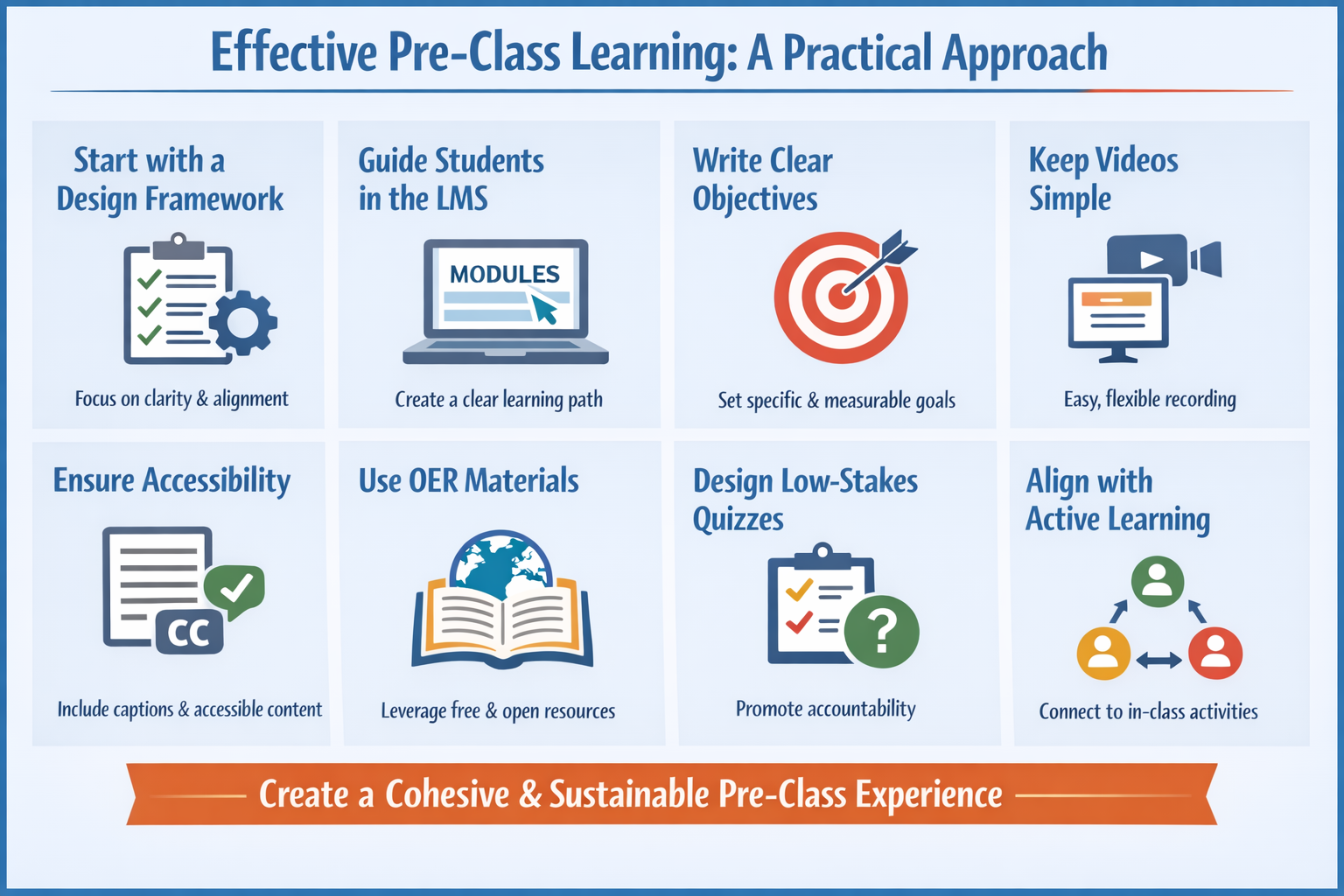
Write Objectives That Signal Purpose
Learning objectives play a critical role in motivating students to prepare before class. Objectives phrased as specific outcomes, rather than activities, help students understand what they should be able to do after engaging with the material.
Using Bloom’s taxonomy or the SMART framework helps instructors avoid vague language and ensures objectives are measurable and meaningful. When students see objectives that are directly connected to in‑class activities and assessments, pre‑class preparation feels purposeful rather than optional.
Keep Video Production Simple and Flexible
High‑quality learning videos do not require expensive studios or complex workflows. Most instructors in this project used PowerPoint’s built-in recording features, paired with tablets or pen-enabled devices, to allow real-time annotation. This approach lowers the barrier to entry while maintaining instructional clarity.
Several practical production tips made recording more efficient:
- Recording slides individually allows instructors to fix mistakes without redoing entire videos.
- Inserting blank slides during recording provides natural pauses and opportunities to retry explanations.
- Retaining editable files makes it easy to update content in future iterations.
The key is not perfection, but clarity and adaptability.
Make Accessibility a Built‑In Feature
Automatic captioning tools, such as those provided by YouTube, significantly reduce the effort required to make videos accessible. While auto‑generated captions are imperfect, they form a strong first draft. We found that generative AI tools can quickly clean transcripts for punctuation and spelling, after which instructors can review for accuracy.
Importantly, accessibility benefits all students, not just those with accommodations, and improves searchability and review efficiency.
Leverage Open Educational Resources Strategically
Relying on textbooks from prior courses can unintentionally disadvantage students who no longer have access. Instead, we recommend using open educational resources or instructor‑created notes for pre‑class review.
Curated, concise readings allow students to focus on precisely the prior knowledge they need, rather than wading through entire chapters. This targeted approach supports equity by ensuring all students start with the same accessible materials.
Design Quizzes for Accountability, Not Punishment
Pre-class quizzes are most effective when they serve as low-stakes accountability tools rather than high-pressure assessments. Creating question banks with both conceptual and algorithmic items allows quizzes to provide meaningful feedback without encouraging rote memorization.
Attention to technical constraints, such as numerical precision limits in LMS grading, helps avoid student frustration. Framing quizzes as formative checkpoints reinforces the message that preparation is part of learning, not a hurdle to clear.
Align Pre‑Class Work with Active Learning
The true payoff of pre‑class preparation occurs during class. When students arrive with foundational knowledge activated, instructors can shift class time toward carefully structured activities using frameworks like ICAP (Interactive, Constructive, Active, Passive).
Across courses, we found that sequencing activities from passive to interactive created a natural progression from exposure to application to collaboration. Pre‑class modules made it possible to move more quickly to higher‑engagement tasks, where deeper learning occurs.
Assess What Matters
Finally, assessment strategies should reflect the goals of pre‑class learning. Combining multiple-choice items for foundational knowledge with open-ended problems for higher-order thinking allows instructors to evaluate both the breadth and depth of understanding. Concept inventories, where available, provide insight into misconceptions and conceptual growth that traditional exams may miss.
Final Thoughts
Developing effective pre‑class learning resources does not require reinventing your course or dramatically increasing workload. By grounding design decisions in research‑based frameworks, making strategic use of technology, and focusing on clarity and alignment, instructors can create sustainable systems that help students come to class better prepared—and ready to learn.
These tips are not isolated tricks; together, they form a cohesive approach to equitable, scalable course design that respects both student learning and faculty time.
References
Kaw, A. K., Clark, R. M., Kibler, K. M, Dallal A., & Uyanik, O. (2026, March). On developing resources for enhancing student success in STEM courses through pre-class learning and prior knowledge integration [Conference session]. 2026 ASEE Southeastern Section Conference, University of Memphis, TN, United States. https://peer.asee.org/57999
Collaborative Research: Using Adaptive Lessons to Enhance Prior Knowledge Activation. (n.d.). Prior Knowledge for Five Engineering Courses. https://priorknowledge.mathforcollege.com