Many universities are getting bent out of shape about AI and assessment, and hence pouring enormous time, energy, and anxiety into a never-ending cat-and-mouse game. New tools show up, new detection schemes follow, and the cycle repeats. Meanwhile, we’re losing the plot: assessment should drive learning, not policing.
Here’s a simple, pragmatic reset: #9090remedy. 90% of courses can allocate 90% of grades to in-class, proctored assessments. If authenticity is the concern, solve it directly. Put students in environments where they demonstrate their thinking in real time. But here’s the non-negotiable: align assessments with learning objectives. If you care about higher-order thinking, your exams must measure it, not just procedural recall.
What about homework? Keep it, but decouple it from grades. Assign meaningful practice and provide rich, timely feedback. Learning thrives in low-stakes environments. Grading often contaminates that.
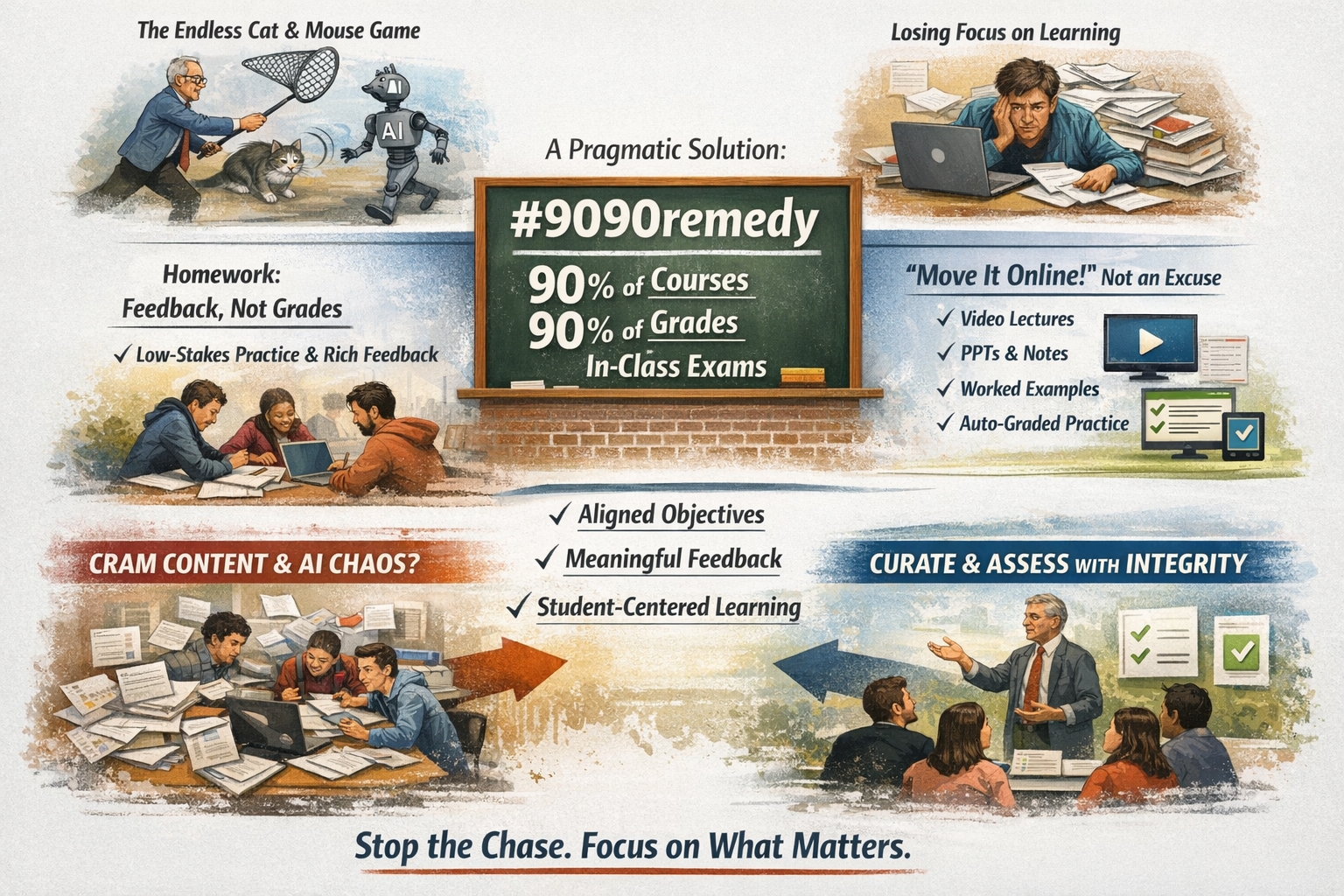
“But this will take too much class time…” Let’s be blunt: that’s an excuse, not a constraint. You already have the solution: move strategically online. Not all content is sacred. Some topics are terminal, useful in the moment, but with minimal impact on future courses. Identify them and reclaim your class time. Then do what we should have normalized years ago: record focused video lectures, provide clean PPTs and structured notes, share worked-out examples, and build formative, auto-graded practice. Now you’ve created space for what matters: authentic assessment and deeper engagement.
Let’s stop pretending we can cover everything, solve AI misuse, and preserve outdated assessment models. That’s not rigor. That’s avoidance. You have a choice: keep cramming content and chase AI misuse forever, or curate your course, move what you can online, and assess what truly matters, in class, with integrity.
What this approach delivers is straightforward: it reduces incentives to game the system, refocuses effort on feedback and course design, and centers student learning over compliance.
So why isn’t this widely adopted? Because it challenges deeply held assumptions about control, grading, and coverage. It disrupts comfort. It dispels the illusion that greater complexity equals greater rigor. It’s much easier to chase the next detection tool than to rethink the design.
We don’t need more complexity. We need alignment, priority, and courage. Stop the wild chase. Start redesigning with intent.